SCHEDULE
The Summer Beit Midrash offers a wide array of fascinating classes taught by world-class Torah educators.
Classes are taught at 3 different levels: Beginners, Intermediate and Advanced.
- Beginners Level is for students with little to no background in textual learning. No Hebrew required.
- Intermediate Level is for students with some background in textual learning, who are comfortable with some Hebrew with translations provided.
- Advanced Level is for students with a high level of experience with textual learning who are comfortable learning sources in Hebrew without being given a translation. Many advanced shiurim are taught entirely in Hebrew.
When you arrive at the Summer Beit Midrash, Program Director Rabbanit Navit Tzadik will meet with you to help you choose the class schedule most suited to your level and interests.
Beginners Level Course Descriptions – Week 1
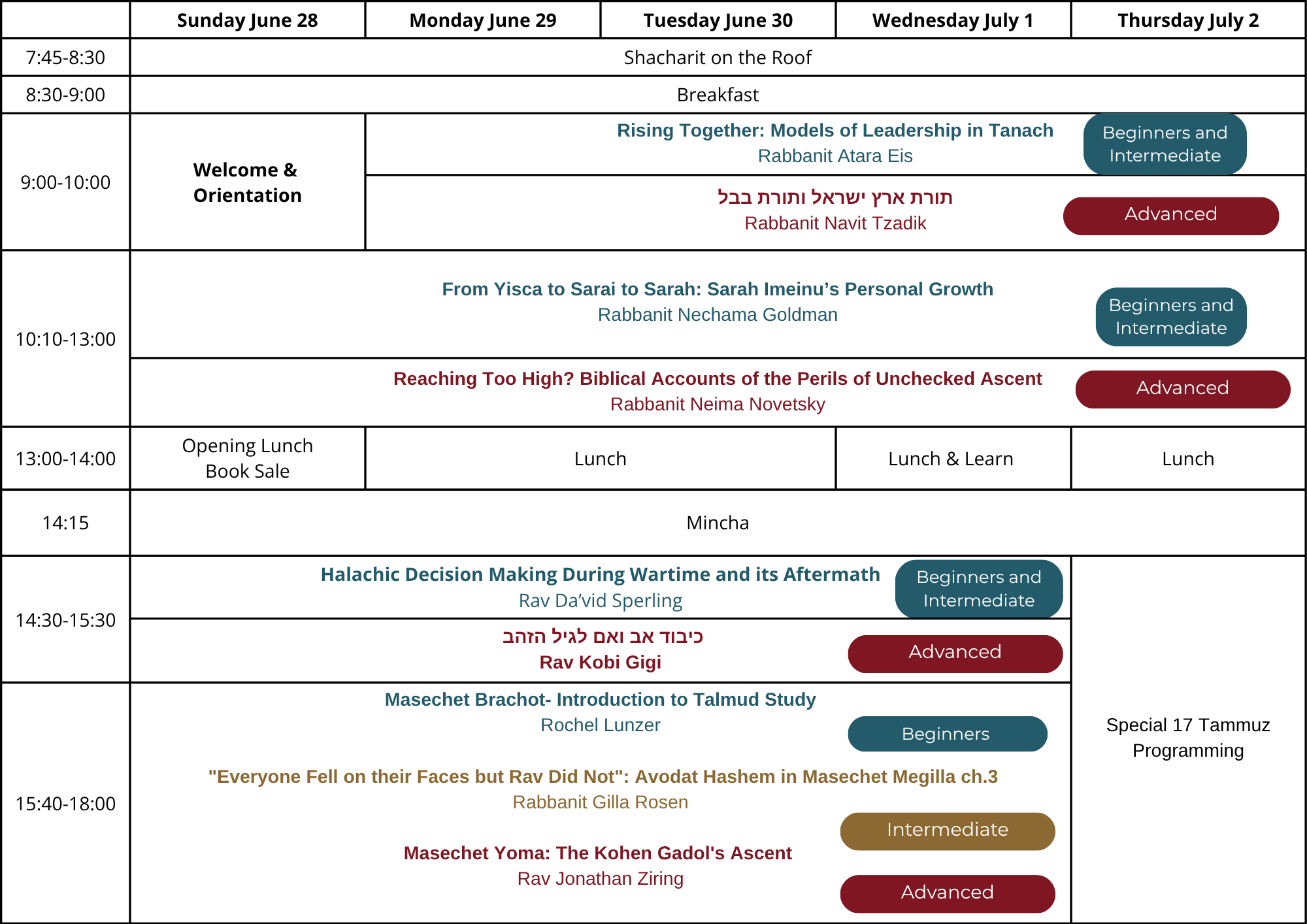
Yiscah to Sarai to Sarah: Sarah Imeinu’s Personal Growth – Rabbanit Nechama Goldman | Sun, June 28- Thurs July 2, 10:10-13:00
This class explores the spiritual journey behind the name changes in the life of Sarah Imeinu—from Yiscah, to Sarai, to Sarah. Through close reading of the Torah, classical commentaries, midrash and chassidut we will examine how names reflect identity, destiny, and inner transformation. Together, we’ll uncover how Sarah’s evolving name mirrors her growth from private spiritual potential to public leadership, and what her journey teaches us about embracing change, purpose, and becoming who we are meant to be.
Halachic Decision-Making During Wartime and its Aftermath – Rav Da’vid Sperling | Sun, June 28- Thurs July 2, 14:30-15:30
This course explores halachic responses to war and its aftermath, focusing on the real dilemmas faced by soldiers, families, and communities. Through concrete cases, we will examine Shabbat observance in military contexts, meta-halachic judgment, Aliyah and enlistment during wartime, and the challenge of sustaining national responsibility amid division. The course concludes with Rav Henkin’s approach to belief in Mashiach.
Introduction to the Oral Law: Foundations of Prayer – Rochel Lunzer | Sun, June 28- Thurs July 2, 15:40-18:00
In this course students will gain an overview of the development, structure, and centrality of the Oral Law, as well as explore topics related to prayer as presented in the oral Jewish tradition. There will be a combination of guided chavruta learning as frontal class time and discussion.
Intermediate Level Course Descriptions – Week 1
“Everyone Fell on their Faces but Rav Did Not”: Avodat Hashem in Masechet Megilla ch.3-Rabbanit Gilla Rosen | Sun, June 28- Thurs July 2, 15:40-18:00
We will study the first mishna of the chapter in its context and then the gemara that develops around it (Masekhet Megilla daf 21-22) exploring ways of learning Gemara. We will look at the sources and meaning of Kri’at HaTorah and of berakhot over mitzvot. The Gemara will take us from holidays to fast days and from “standing before God” to bowing before Him in the Beit Hamikdash.
Advanced Level Course Descriptions – Week 1
תורת ארץ ישראל ותורת בבל אמרי במערבא – הרבנית נוית צדיק Sun, June 28- Thurs July 2, 9:00-10:00
אמרי במערבא:הבדלים בין הבבלי וירושלמי בהנהגת הקב”ה בעולמו
אמרי במערבא: הבדלים בין הבבלי וירושלמי בטעמי המצוות אמרי במערבא: הבדלים בין הבבלי וירושלמי ביחס לגויים
אמרי במערבא: הבדלים בין הבבלי וירושלמי ביחס לגאולה אמרי במערבא: הבדלים בין הבבלי וירושלמי על חיובים והתנדבות
אמרי במערבא: הבדלים בין הבבלי וירושלמי על שכר ועונש אמרי במערבא: הבדלים בין הבבלי וירושלמי ליחס סוגיות סגוליות
אמרי במערבא: הבדלים בין הבבלי וירושלמי ב יוחסין
אמרי במערבא: הבדלים בין הבבלי וירושלמי ב יחס לתלמידי חכמים ישנם הבדלים רבים בין התלמוד הבבלי לתלמוד הירושלמי.
הבדלים אלה משקפים עולמות רוחניים שונים והתמודדויות שונות עמם התמודדו חכמי בבל ו ארץ ישראל. עיון בהבדלים אלה מאפשר לעמוד על הפערים השקפתיים בין שני התלמודים ובין חכמיהם . היחס השונה של כל אחד מן התלמודים לשאלות יסוד מעניק מבט רחב ומרתק על דרכי ההתמודדות הייחודיות של כל קהילה, והבחנה זו עשויה לשפוך אור גם על ההבדלים בין הקהילות היהודיות בימינו, בארץ ובתפוצות
Reaching Too High ? Biblical Accounts of the Perils of Unchecked Ascent – Rabbanit Neima Novetsky | Sun, June 28- Thurs July 2, 10:10-13:00
We normally assume that striving to come close to Hashem is a positive endeavor. Is it possible, though, to reach too high? How are we to view Nadav and Avihu’s desire to bring an extra incense offering? On one hand, it obviously leads to their death, implying that it was sinful, yet in the very next verse they are described as being Hashem’s “close ones”, implying that even in death they are respected! What is so problematic about Korach’s call for equality in worship; if we are truly a “kingdom of priests” as Hashem Himself said, then should we not all seek priestly service? Shemot 24 speaks of the nobles of Israel “seeing Hashem” at Sinai. Considering that we assume that Hashem is not a corporeal being, what does it mean to see Him? This mini course will explore these and other stories, turning to both classical and modern parshanim to answer these questions and more.
כיבוד אב ואם לגיל הזהב – הרב קובי גיגי | Sun, June 28- Thurs July 2, 14:30-15:30
בסדרה נלמד על החובה הבסיסית של כיבוד הורים ונראה שעיקר הציווים של כבוד שייכים ביחס לגיל המבוגר. לאחר מכן נדון בשאלה האם כיבוד הורים קודם לצרכים של הבן כמו פרנסה וכדומה. כמו כן נדון בשאלה האם מותר לבצע טיפול במצב רפואי בניגוד לרצון ההורים או בלי ידיעה מה הם רוצים. בנוסף האם מצד כיבוד הורים עדיף ההורה יגור אצל הילד או בבית אבות.
Masechet Yoma: The Kohen Gadol’s Ascent – Rav Jonathan Ziring | Sun, June 28- Thurs July 2, 15:40-18:00
Masechet Yoma traces the ascent of the Kohen Gadol.Through seven days of separation and preparation, a mere human being readies himself to encounter God in the Holy of Holies. Step by step, he moves closer to that meeting in the cloud of the ketoret, alone carrying the fate of the Jewish people with him. By learning Yoma, we follow that same arc, both temporally and geographically, toward closeness with God. While the eighth chapter, which presents the familiar laws of Yom Kippur such as fasting, has been widely studied, much of the tractate remains overlooked. We will turn to those chapters and step into the world of the Kohen Gadol
Beginners Level Course Descriptions – Week 2
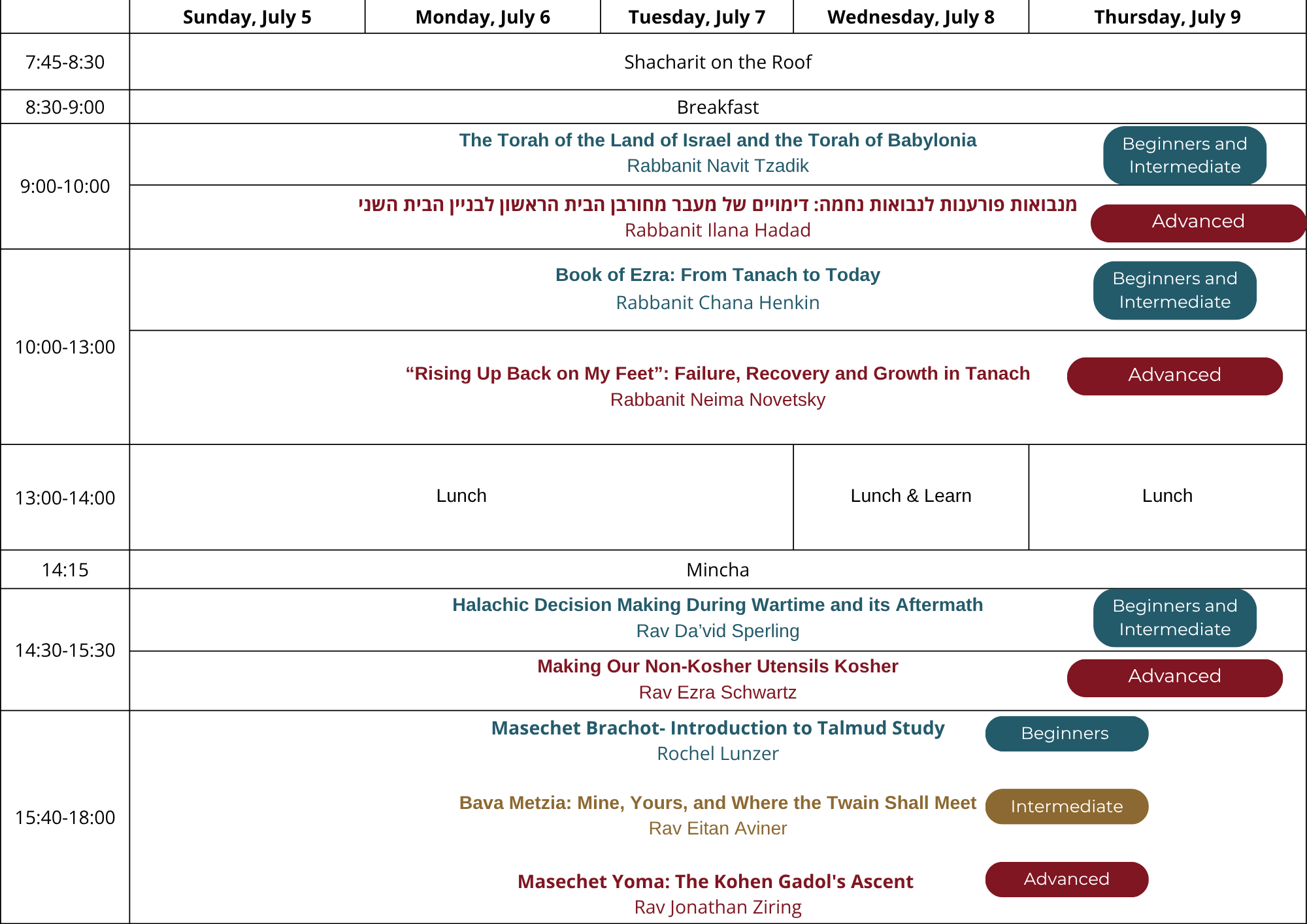
The Torah of the Land of Israel and the Torah of Babylonia – Rabbanit Navit Tzadik Sun, July 5- Thurs July 9, 9:00-10:00
There are many differences between the Babylonian Talmud and the Jerusalem Talmud. These differences reflect diverse world views and different modes of response developed by the sages of Babylonia and the Land of Israel. Examining these differences makes it possible to identify the ideological gaps between the two Talmuds and their sages. The contrasting approaches each Talmud takes to basic questions offer a clear and engaging window into how each community dealt with its circumstances and this insight may also shed light on the differences among Jewish communities today, in Israel and in the Diaspora.
- Differences between the Babylonian and Jerusalem Talmuds concerning the reasons for the commandments
- Differences between the Babylonian and Jerusalem Talmuds in their attitude toward non-Jews
- Differences between the Babylonian and Jerusalem Talmuds regarding miraculous stories
- Differences between the Babylonian and Jerusalem Talmuds regarding lineage
- Differences between the Babylonian and Jerusalem Talmuds in their attitude toward Torah scholars
Book of Ezra, From Tanach to Today – Rabbanit Chana Henkin Sun, July 5- Thurs July 9, 10:10-13:00
Rabbanit Henkin is writing a book on Ezra and Nechemia. Five days of vigorous text-based learning, as relevant today as in the days of the Tanach.
Halachic Decision-Making During Wartime and its Aftermath – Rav Da’vid Sperling Sun, July 5- Thurs July 9, 14:30-15:30
This course explores halachic responses to war and its aftermath, focusing on the real dilemmas faced by soldiers, families, and communities. Through concrete cases, we will examine Shabbat observance in military contexts, meta-halachic judgment, Aliyah and enlistment during wartime, and the challenge of sustaining national responsibility amid division. The course concludes with Rav Henkin’s approach to belief in Mashiach.
Introduction to the Oral Law: Foundations of Prayer – Rochel Lunzer Sun, July 5- Thurs July 9, 15:40-18:00
In this course students will gain an overview of the development, structure, and centrality of the Oral Law, as well as explore topics related to prayer as presented in the oral Jewish tradition. There will be a combination of guided chavruta learning as frontal class time and discussion.
Intermediate Level Course Descriptions – Week 2
Bava Metzia 2a–4a: Mine, Yours, and Where the Twain Shall Meet – Rav Eitan Aviner Sun, July 5- Thurs July 9, 15:40-18:00
Many cases brought before a beit din center on monetary disputes between two individuals. The opening sugyot of Bava Metzia are classic not only because they address these conflicts, but because of a subtle twist: what happens when the sides disagree about much of the claim , yet agree about part of it? How does partial agreement reshape the entire legal picture?
Through a close reading of these foundational passages, we will explore how the Gemara navigates competing claims, trust, and oath-taking, revealing a striking encounter between law and human nature. This is an opportunity both to enter the world of Talmudic reasoning and to glimpse Chazal’s profound understanding of the psychology of conflict.
Advanced Level Course Descriptions – Week 2
מנבואות פורענות לנבואות נחמה: דימויים של מעבר מחורבן הבית הראשון לבניין הבית השני – הרבנית אילנה חדד Sun, July 5- Thurs July 9, 9:00-10:00
נלך יחד בין החורבן לבין בנין הבית השני ונלמד איך הנבואות הופכות מפורענות לנחמה.
Rising Up, Back on My Feet – Rabbanit Neima Novetsky Sun, July 5- Thurs July 9, 10:10-13:00
Mishlei 16 states, “A righteous man falls down seven times and gets up” teaching that not even the righteous are immune to failure and hardship. Where they differ from others is their ability to get up afterwards. So, what does Tanakh, in both its halakhic and narrative sections, have to teach us about rising after falling? Sefer Bemidbar speaks about accidental killings; what does the institution of cities of refuge imply about how (and if) one can forgive one’s self after having done the unforgivable? How does Torah suggest to fix a marriage in which all trust has been broken; is it possible to come out stronger in the end? When David HaMelekh commits two out of the three cardinal sins, how does he get back on track?
Elevating What We Eat: Hechsher Keilim – Rav Ezra Schwartz Sun, July 5- Thurs July 9, 10:10-13:00
This advanced-level class explores the halachic principles of kashering utensils, analyzing which method—soaking, boiling (hag‘alah), or intense heat (libun)—is required based on how the utensil became non-kosher and the material from which it is made, including cases where kashering is not possible.
Masechet Yoma: The Kohen Gadol’s Ascent – Rav Jonathan Ziring Sun, July 5- Thurs July 9, 15:40-18:00
Masechet Yoma traces the ascent of the Kohen Gadol. Through seven days of separation and preparation, a mere human being readies himself to encounter God in the Holy of Holies. Step by step, he moves closer to that meeting in the cloud of the ketoret, alone carrying the fate of the Jewish people with him. By learning Yoma, we follow that same arc, both temporally and geographically, toward closeness with God. While the eighth chapter, which presents the familiar laws of Yom Kippur such as fasting, has been widely studied, much of the tractate remains overlooked. We will turn to those chapters and step into the world of the Kohen Gadol.
Pricing
Full Program no dorm
$1400
3 weeks of full-time learning not including staying in Nishmat’s dormitory
Full Program with dorm
$1950
3 weeks of full-time learning while staying in Nishmat’s dormitory on-campus
Weekly Full-Time no dorm
$500
One week of full-time learning not including staying in Nishmat’s dormitory.
Weekly Full-Time with dorm
$700
One week of full-time learning while staying in Nishmat’s dormitory on-campus.
Half-Time or Part-Time
Pricing will be determined according to each student’s planned schedule of classes.
*Discounts are available to alumnae who studied full-time for a full year at Nishmat as well as for Israeli citizens residing in Israel. These discounts will be explained upon acceptance to the program.
**Breakfast and lunch are included for all full-time students (dinner is excluded). Part-time students can sign up for an additional fee.