June 2026
When women experience Obsessive-Compulsive Disorder (OCD) in the context of Taharat Hamishpacha, the challenges extend beyond mental health, often creating significant distress around their observance of halacha, turning deeply meaningful religious practice into a source of anxiety and uncertainty. Effective support requires professionals in both the medical and halachic fields to learn how best to work together.
Nishmat’s U’metzena Menucha initiative was developed to provide exactly that: coordinated therapeutic support and halachic guidance tailored to each woman’s individual needs.
The initiative grew directly out of the fieldwork of Nishmat’s Yoatzot Halacha, who identified a growing need for specialized support for women struggling with OCD in Taharat Hamishpacha. What began as a guidance booklet produced by Nishmat’s Research Institute grew into a fully-fledged service for women seeking support.
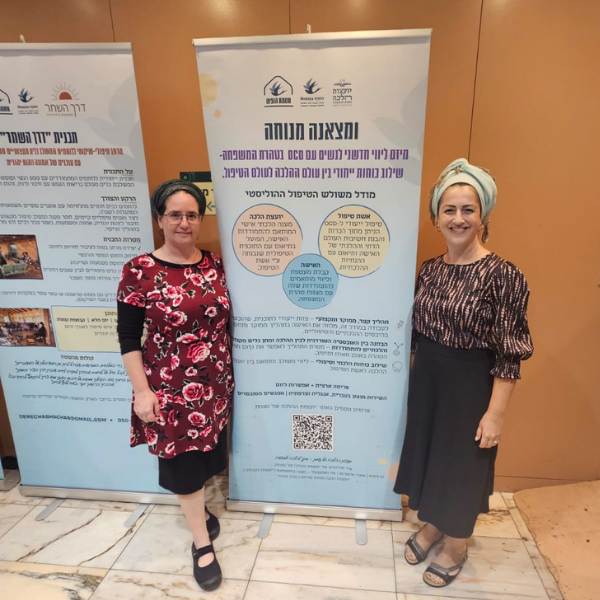
Led by Ayelet Habba, Director of Nishmat’s Golda Koschitzky Center, and Yoetzet Halacha Sarit Chen Kroitoro, a social worker with expertise in OCD treatment, the initiative was selected by the Coalition of Religious Mental Health Organizations (Homiya) to participate in its innovation incubator.
Over ten months, the project received professional mentorship from Professor Israel Straus, Head of Psychiatry at Maayanei HaYeshua Hospital, as well as a NIS 20,000 grant to support its development.
Building a Cohesive Model
At the heart of U’metzena Menucha is collaboration between professionals who bring different areas of expertise to a woman’s care.
The incubator brought together 37 specialists – 18 Yoatzot Halacha and 19 mental health professionals – for an intensive training process. By combining expertise in Jewish law and mental health treatment, the teams developed a structured model for responding to cases in which halachic concerns and OCD intersect.
Every woman who approaches the program begins with an in-depth intake process. From there, the team develops a personalized care plan designed to address both the therapeutic and halachic elements of her experience.
“This initiative enables us to provide the most accurate response for each woman, addressing both the halachic and emotional aspects in the most professional and personalized way,” says Ayelet Habba. “The incubator enabled us to bring this important initiative to life, and we are deeply grateful for its guidance, support, and trust.”
From Ideation to Reality
Following the completion of its intensive development and training period, Nishmat launched U’metzena Menucha to begin reaching women in need of this specialized support.
To date, the initiative has already received 53 inquiries, held 24 intake interviews and is currently supporting 19 active cases. Through U’metzena Menucha, Nishmat is building a framework in which women facing these complex challenges feel seen, heard and supported.